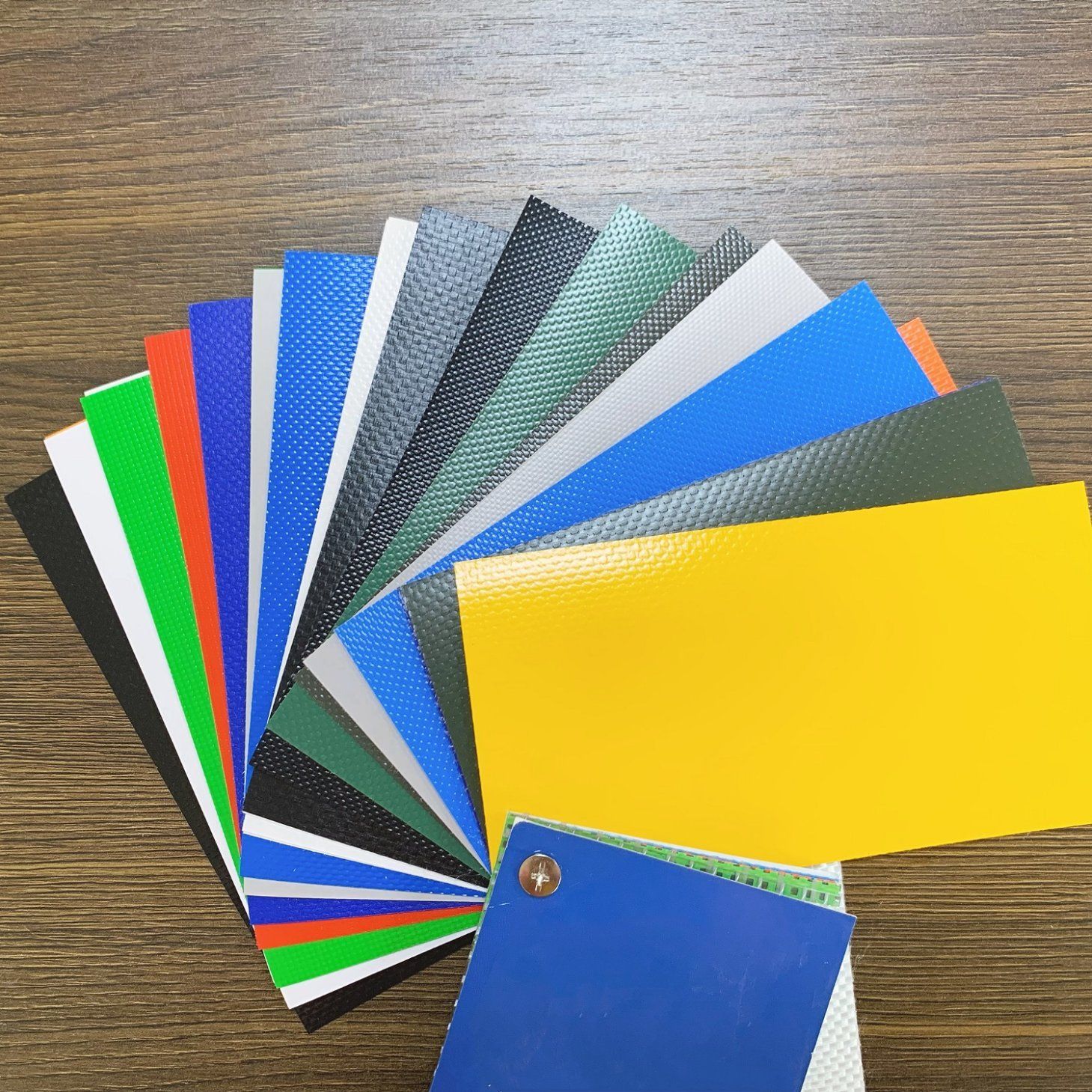
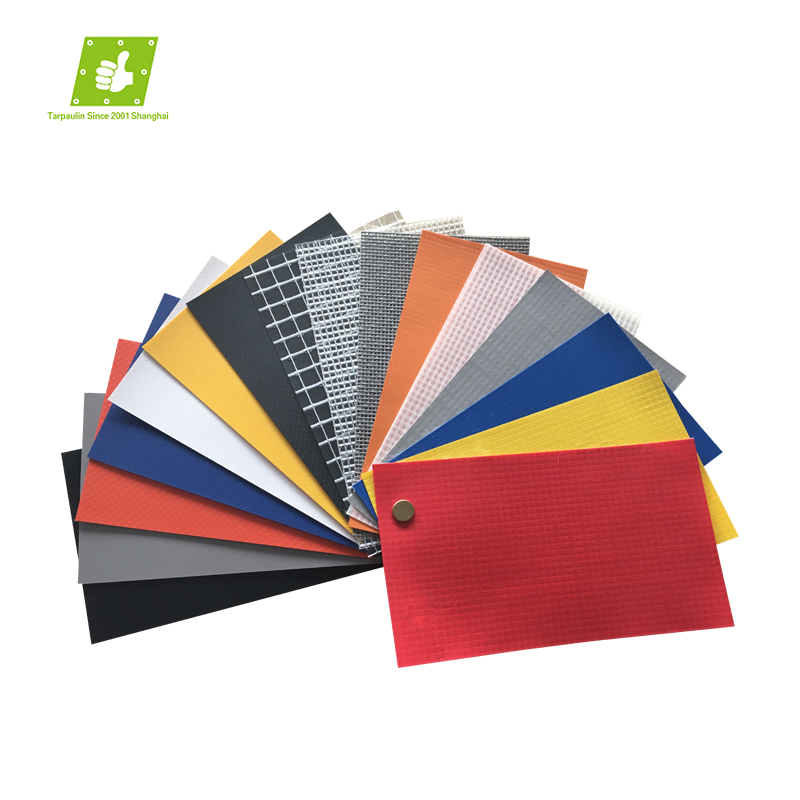
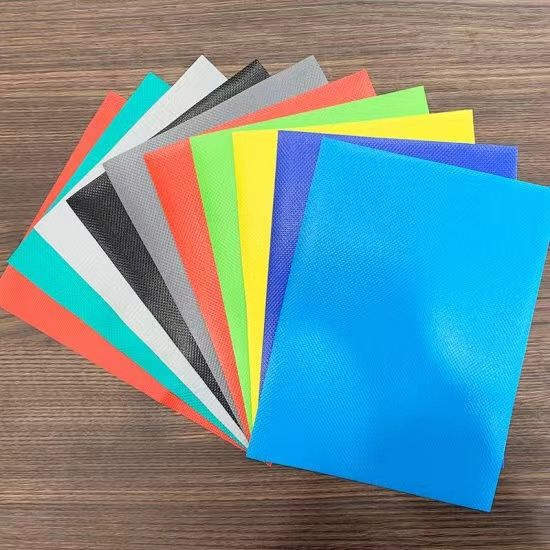
I. The core characteristics of PVC Canvas Tarpaulin: the unique value given by the canvas base fabric
The advantages of PVC Canvas Tarpaulin stem from the synergistic effect of "canvas base fabric" and "PVC coating". Compared with ordinary PVC tarpaulins (mostly polyester or nylon base fabrics), its characteristics are more suitable for specific scene needs, which can be summarized in four points:
1. Ultra-high strength and toughness to cope with complex stress scenarios
Canvas base fabric (especially cotton canvas) has high fiber interweaving density and high breaking strength, and naturally has excellent tensile and tear resistance. Taking the common 16-gauge cotton canvas as an example, its warp breaking strength is ≥800N/5cm, and the weft direction is ≥700N/5cm, far exceeding the ordinary polyester base fabric (warp direction ≥500N/5cm). After being coated with PVC coating, the strength and toughness of the canvas base fabric is further improved, and the tear resistance can reach 1.5-2 times that of ordinary PVC tarpaulin. This feature makes it particularly suitable for scenes that require frequent pulling and load-bearing, such as truck tarpaulins (not easily scratched by edges and corners when covering heavy goods), outdoor tents (withstanding strong wind pulls), and temporary construction fencing (withstanding collisions by people or scratches by tools).
2. Moderate breathability to avoid stuffiness and condensation
The coating of ordinary PVC tarpaulin is dense and the base fabric has poor air permeability. If it covers a closed space (such as a truck compartment, a temporary warehouse) for a long time, condensation water will easily be generated, causing the goods to become damp. The canvas base fabric has a natural microporous structure, and even if it is coated with PVC coating, it can still retain moderate air permeability (the air permeability is usually 5-10L/m²·s), which can achieve micro-circulation of air and reduce the generation of condensation water. For example, when transporting goods such as food and furniture that are susceptible to moisture during the rainy season, PVC Canvas Tarpaulin can balance waterproofness and breathability to prevent the goods from getting moldy; when used in outdoor awnings, it can also reduce the stuffiness inside the shed and improve comfort.
3. Excellent texture and wear resistance, suitable for high-frequency contact scenarios
The surface texture of the canvas base fabric is rough and thick. After being coated with PVC coating, it forms a "matte texture + wear-resistant surface layer". The tactile and visual effects are far superior to the smooth surface of ordinary PVC tarps. Its surface abrasion resistance (Martindale abrasion test ≥5000 times) is also better, and it is suitable for scenes with high frequency of human contact or friction, such as outdoor leisure tents (people come in and out frequently and are not easy to wear), market stall tarpaulins (goods handling has a lot of friction), and breeding shed tarpaulins (livestock contact is not easy to be damaged). At the same time, the anti-aging performance of the canvas base fabric is more stable, and it is not prone to surface cracking or fading during long-term outdoor use. The service life can reach 5-7 years, which is 2-3 years longer than ordinary PVC tarpaulin.
4. Good plasticity, easy to process into complex structures
The flexibility and wrinkle resistance of canvas base fabric are better than ordinary chemical fiber base fabric. It can still maintain good folding and sewing performance after being coated with PVC coating. It can be processed into complex structures with wrinkles and curvature, such as outdoor canopies (requiring polygonal splicing and drape), equipment dust covers (requiring to fit irregular shapes), and canvas trolley canopies (requiring frequent folding and storage). In comparison, ordinary PVC tarpaulin is prone to permanent creases after folding, and the coating is prone to peeling off during sewing, and its processing adaptability is far less than that of PVC Canvas Tarpaulin.
II. PVC Canvas Tarpaulin vs. Ordinary PVC Tarpaulin: 4 core differences, accurate distinction
Many users confuse the two, but in fact there are essential differences in terms of base fabric, performance, scene adaptation, etc. Accurate distinction is the key to selection:
1. Differences in base fabric: natural/canvas texture vs chemical fiber lightness
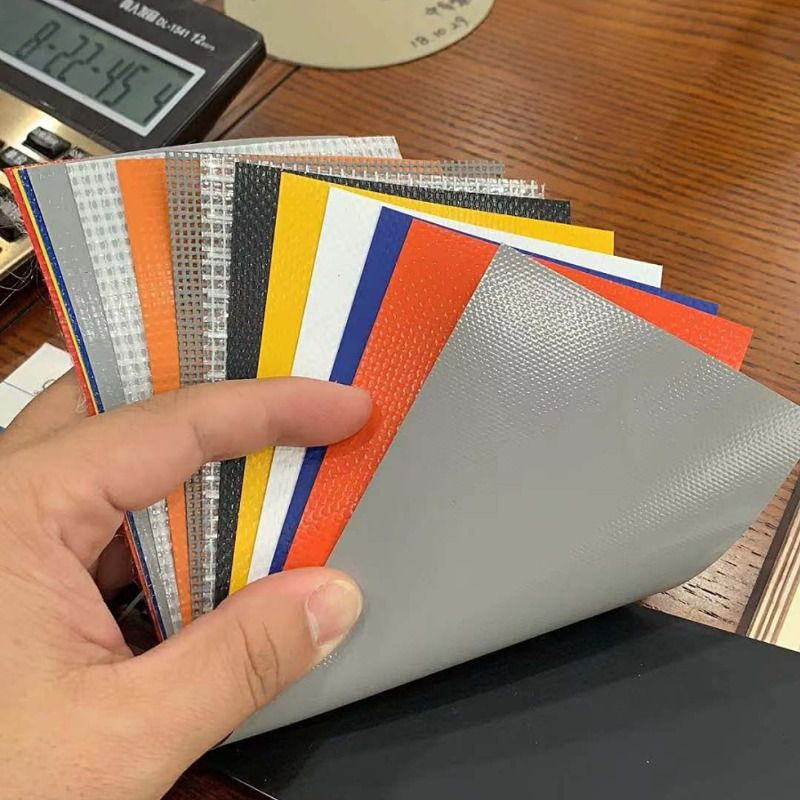
In terms of base fabric material, PVC Canvas Tarpaulin mainly uses cotton canvas or polyester canvas and other base fabrics with a canvas texture, while ordinary PVC tarpaulins mostly use polyester cloth, nylon cloth and other light and thin chemical fiber materials; in terms of base fabric thickness, the base fabric of PVC Canvas Tarpaulin is usually thicker, with a thickness range of 0.3-0.5mm, while the base fabric of ordinary PVC tarpaulin is thinner, usually 0.3-0.5mm. 0.1-0.3mm; in terms of surface texture, PVC Canvas Tarpaulin has a matte effect, with a rough texture, and has a clear canvas touch when touched, while ordinary PVC tarpaulin has a glossy surface, smooth texture, and strong plastic texture; in terms of weight, PVC Canvas Tarpaulin has a thicker base fabric and can weigh up to 600-1000g per square meter, while ordinary PVC tarpaulin is lighter, only 300-600g per square meter. This difference in base fabric directly determines that PVC Canvas Tarpaulin is more suitable for scenarios that require "texture + strength", while ordinary PVC tarpaulin is more suitable for scenarios that require "lightweight + low cost".
2. Performance difference: strong and breathable vs waterproof and lightweight
In terms of air permeability, PVC Canvas Tarpaulin can retain moderate air permeability, with an air permeability of usually 5-10L/m²·s, while ordinary PVC tarpaulins are almost airtight, with an air permeability of less than 1L/m²·s; in terms of tear resistance, PVC Canvas Tarpaulin has a tear resistance of ≥300N/25mm, which is 1.5 times higher than ordinary PVC tarpaulins (≥200N/25mm). times; in terms of wear resistance, the Martindale wear resistance of PVC Canvas Tarpaulin is ≥5000 times, which is 60% higher than that of ordinary PVC tarpaulins (≥3000 times); in terms of portability, ordinary PVC tarpaulins are more suitable for frequent handling scenarios due to their light weight, while PVC Canvas Tarpaulin is heavier and more suitable for fixed use or low-frequency moving scenarios.
3. Differences in scenarios: high-frequency contact vs basic protection
PVC Canvas Tarpaulin is mainly suitable for "high-frequency contact + complex stress + light breathability" scenarios, such as truck tarpaulins (used to cover heavy goods, which need to resist scratches and pulls during transportation), outdoor leisure tents (people come in and out frequently, and require texture and breathability), market stall tarpaulins (daily transportation of goods has a lot of friction, and need to be wear-resistant and avoid stuffy goods), breeding sheds (livestock are in frequent contact, and moderate ventilation is required to adjust the environment inside the shed); General PVC tarpaulins are more suitable for "basic waterproofing + lightweight + low cost" scenarios, such as short-term cargo coverage (only temporary waterproofing, no long-term durability), ordinary awnings (mainly to block sunlight, low requirements for texture and strength), agricultural greenhouse auxiliary tarpaulins (as auxiliary protection, focusing on low cost and light installation).
For example: "Fixed stalls in suburban markets need to cover goods (fruits, vegetables) every day, personnel frequently load and unload and the goods need to be kept away from stuffy heat" - choose PVC Canvas Tarpaulin (breathable + wear-resistant + good texture); "warehouses cover idle cartons for a short period of time and only need basic waterproofing" - choose ordinary PVC tarpaulin (low cost + light).
|
4. The difference between cost and life: long-term durability vs short-term economics
The purchase cost of PVC Canvas Tarpaulin is relatively high. The price per square meter is 30-50 yuan, which is 50%-100% higher than ordinary PVC tarpaulin (15-30 yuan per square meter). However, in terms of service life, PVC Canvas Tarpaulin can last up to 5-7 years, which is more than twice that of ordinary PVC tarpaulin (2-3 years). The long-term use cost is actually lower. Taking the truck tarpaulin scene as an example, although the initial investment of PVC Canvas Tarpaulin is high, it does not need to be replaced within 5 years; ordinary PVC tarpaulin needs to be replaced 2-3 times within 5 years, and the cumulative investment cost is even higher.
III. How to choose PVC Canvas Tarpaulin? 5-step lock-in adaptation product
The core of selection is the matching of "base fabric material + coating process + scene requirements" to avoid insufficient performance due to "wrong selection of base fabric". The specific steps are as follows:
1. Determine the type of base fabric: cotton canvas vs chemical fiber canvas
The characteristics of different base fabrics are significantly different, and they need to be selected according to the scene:
Cotton canvas base fabric: The advantage is good air permeability (10-15L/m²·s) and good texture. It is suitable for scenes with high requirements on breathability and texture (such as outdoor leisure tents and market stall tarpaulins); its limitation is that it is highly hygroscopic (it is easy to absorb moisture and gain weight in rainy days or high-humidity environments), and it is prone to mold after long-term soaking, so it needs to be dried regularly.
Chemical fiber canvas base fabric (such as polyester canvas): has the advantages of being moisture-proof and mildew-proof (hygroscopicity <5%), and excellent anti-aging performance, and is suitable for humid or long-term outdoor use scenarios (such as truck tarpaulins, breeding sheds); limitations are slightly poor air permeability (5-8L/m²·s), and a slightly inferior texture than cotton canvas.
For example: "Outdoor breeding shed in the rainy season in the south" - choose polyester canvas base fabric (moisture-proof and mildew-proof); "Outdoor camping tent in the dry area of the north" - choose cotton canvas base fabric (breathable + texture).
2. Confirm the coating process: scraping vs. dip coating to suit the protection needs
The PVC coating process directly affects waterproofing and durability:
Scratch coating process: The coating thickness is uniform (0.1-0.2mm), the surface is smooth, and the waterproofing is stable (waterproof grade ≥ 1500mm water column), suitable for scenes with high waterproofing requirements (such as truck tarpaulins, outdoor canopies);
Dip coating process: The coating penetrates the fibers of the base fabric, has strong adhesion (peel strength ≥ 4N/25mm), and excellent friction resistance, and is suitable for high-frequency friction scenarios (such as trolley tarps, equipment dust covers).
Professional manufacturers such as Qidong Good Tarpaulin can provide products with corresponding coating processes according to customer scene needs. For example, polyester canvas base fabric PVC tarpaulins with scratch coating technology are provided for truck tarpaulin needs to ensure waterproofing and durability.
3. Verify key performance indicators to avoid inferior products
No professional equipment is required, and the quality can be initially judged through the following methods:
Density of base fabric: Observe the texture of the canvas. The warp and weft threads of high-quality products are closely intertwined with no obvious gaps; when the base fabric is pulled by hand, there is no obvious deformation or loose fibers (inferior products may have warp or weft threads broken).
Coating adhesion: Gently scratch the coating surface with your fingernails, no obvious scratches or coating peeling off; tear the joint between the coating and the base fabric hard, no signs of delamination (the dip coating process should be completely free of peeling).
Waterproofing: Pour water on the surface of the coating and observe whether complete water droplets form (no diffusion, no penetration); turn over the tarpaulin after letting it sit for 10 minutes, and there will be no signs of water seepage on the inside.
Breathability: Cover the mouth of the hot water cup with a tarpaulin (cup mouth diameter 10cm), and observe whether there is fog above the cup mouth (fog indicates good air permeability; if there is no fog, it may be an ordinary PVC tarpaulin).
4. Clarify size and processing requirements: standard vs customized
|
Standard model: Suitable for regular size needs, such as outdoor awnings and small truck tarpaulins. Qidong Good Tarpaulin’s standard products are in sufficient stock and can be shipped in 3-5 days. The price is 10%-15% lower than the customized model;
Customized models: Suitable for special size or structural requirements (such as oversized truck tarpaulins, temporary tents with doors and windows), detailed dimensional drawings or scene descriptions are required. The manufacturer cuts and sews according to needs. For example, Qidong Good Tarpaulin's customization service can provide "size cutting + edge wrapping + buttonhole installation" full-process processing to ensure that the product adapts to the scene.
5. Confirm additional functions based on frequency of use and environment
Select additional functions according to the needs of the scene to improve the user experience:
Anti-mildew treatment: Humid environments (such as the rainy season in the South) require products with anti-mildew treatment (anti-mildew level ≥0, that is, no mold growth);
Anti-UV treatment: For long-term outdoor use scenarios (such as truck tarps, outdoor canopies), products with anti-UV agents (UV blocking rate ≥ 90%) need to be selected to delay aging;
Flame retardant treatment: Industrial or public scenes (such as temporary construction fences, market stalls) need to choose flame retardant products (flame retardant grade ≥ UL94 V-2) to improve safety.
IV. Scenario-based application of PVC Canvas Tarpaulin: key points of use and maintenance
The use and maintenance methods in different scenarios need to be adjusted based on their characteristics to maximize the lifespan:
1. Truck tarpaulin: focus on fixation and moisture-proofing
Key points for use: When covering goods, make sure the tarpaulin is completely wrapped, and the edges are tightly fixed with ropes (one fixed point every 50cm) to prevent the tarpaulin from being blown up by the wind while the vehicle is moving; when loading goods that are susceptible to moisture (such as grain), a layer of plastic film can be laid on the inside of the tarpaulin to further isolate moisture.
Maintenance points: Clean the dust and debris on the surface after each use. If it rains, it needs to be dried in time (especially the cotton canvas base fabric) to avoid moisture absorption and mold; regularly check whether the coating is damaged. Small damages can be sealed with PVC special repair glue. Large damages need to be repaired by contacting the manufacturer (for example, Qidong Good Tarpaulin can provide professional repair services).
2. Outdoor leisure tent: focus on breathability and storage
Key points for use: When setting up, choose a flat ground to avoid poking the tarp with sharp objects; when using it on rainy days, ensure smooth drainage around the tent to avoid water accumulation from collapsing the tarp; properly open the tent vents at night or when people leave, and use the breathability of the tarp to reduce condensation water.
Maintenance points: Dry thoroughly after use (especially cotton canvas base fabric), avoid heavy pressure when folding and storing (to prevent permanent creases); when not in use for a long time, take it out to dry regularly to prevent mold growth.
3. Breeding sheds: Pay attention to moisture-proofing and cleanliness
Key points for use: When installing, ensure that there is a 5-10cm gap between the tarpaulin and the scaffolding to increase air circulation and reduce moisture in the shed; regularly open the shed for ventilation and use the breathability of the tarpaulin to adjust the humidity in the shed.
Maintenance points: Clean feces and dust on the surface of the tarpaulin every week (can be cleaned with clean water and a soft brush) to avoid long-term accumulation of dirt and corrosion of the coating; check the fixed points on the edge of the tarpaulin every 3 months, and replace loose ropes or buttonholes in a timely manner.



 Español