1. What are the “localization” requirements for the core properties of PVC canvas due to the extreme climate in Saudi Arabia? How does Qidong Good Tarpaulin fit in?
Saudi Arabia has a tropical desert climate, and its core climate characteristics are "three highs and two lows": high temperature (average daily summer temperature is 38-45°C, with extreme temperatures reaching over 50°C), high ultraviolet rays (annual sunshine hours exceed 3,000 hours, and ultraviolet intensity UVI often reaches 11+), high sandstorms (the average annual number of sandstorm days in the northern desert exceeds 20 days), and low precipitation (annual precipitation is less than 200mm) and low humidity (the average annual relative humidity is only 30%-40%). This climate has significantly different performance requirements for PVC canvas, and Qidong Good Tarpaulin achieves precise adaptation through customized production:
(1) Anti-high temperature and anti-aging are the basic bottom line
Ordinary PVC canvas is prone to softening, adhesion or even melting of the coating above 40°C. However, the surface temperature in Saudi Arabia can exceed 70°C in summer, so the canvas must have high temperature resistance and stability. During production, Qidong Good Tarpaulin will specifically add organic tin-based high-temperature stabilizers for Saudi orders to ensure that the softening temperature of the coating is not lower than 60°C. At the same time, high heat-resistant polyester filament base fabric will be selected to avoid shrinkage and deformation at high temperatures. For example, the canvas customized for the outdoor oil tank covering scene in Saudi Arabia will pass a 72-hour continuous exposure test at 50°C to ensure that there is no coating peeling and a dimensional change rate of ≤1%, fully meeting the sun protection requirements of oil tanks.
(2) Anti-ultraviolet rays and sand abrasion are core requirements
Strong ultraviolet rays will accelerate the breakage of PVC molecular chains, causing the canvas to become brittle and crack. Qidong Good Tarpaulin will add nano-scale titanium dioxide anti-UV agent to the canvas in the Saudi market to make the product UPF (ultraviolet protection factor) ≥50+, ensuring that the tear strength retention rate after 5 years of outdoor use is no less than 70%. To address the wear and tear problem caused by desert wind and sand, a combination of "high wear-resistant PVC coating + high-density base fabric" is used. The coating thickness is controlled at 0.5-0.6mm, and the density of the base fabric is ≥600 denier. For example, canvas customized for desert camp tents will pass 1,000 wind and sand friction tests without obvious fluffing, and its service life is increased by more than 40% compared with ordinary canvas.
(3) Fire protection and antistatic properties need to be strengthened
Saudi Arabia is rich in oil and gas resources. Oil and gas fields and refinery scenarios have mandatory requirements for the fire resistance of PVC canvas. The corresponding products produced by Qidong Good Tarpaulin will strictly follow the Saudi SASO 1470:2019 standard and pass the vertical combustion test (afterburning time ≤ 3 seconds, smoldering time ≤ 10 seconds). At the same time, in order to solve the risk of static electricity caused by wind and sand friction in dry environments, conductive fibers will be added to the industrial canvas coating to control the surface resistance between 10⁶-10⁹Ω, and anti-static grounding accessories will be provided, such as canvas customized for oil field temporary storage sheds, which can directly comply with oil field anti-static safety regulations without additional modifications.
2. What are the different preferences for the specifications of PVC canvas in Saudi Arabia’s main industries (oil and gas, construction, agriculture)? How is Qidong Good Tarpaulin supplied?
Saudi Arabia’s industrial structure is highly concentrated. The oil and gas industry, construction industry and modern agriculture are the three core demand areas for PVC canvas. Its specification preferences are deeply bound to application scenarios. Qidong Good Tarpaulin can provide customized supply solutions according to different industrial needs:
(1) Oil and gas industry: mainly heavy-duty and high-protection specifications
As the world's largest oil and gas exporter, the protection needs of Saudi Arabia's oil and gas fields, refineries and ports account for more than 40% of the PVC canvas market, and 1300D-1600D high D-value heavy-duty canvas is generally preferred. For this field, Qidong Good Tarpaulin will use 1600D high-strength polyester fiber in the base fabric selection, add oil-resistant agents and flame retardants to the coating, give priority to black color (to enhance heat insulation), and double-reinforce the edges with stainless steel eyelets and fireproof ropes. For example, the equipment protective canvas supplied to Saudi Aramco oil-related projects passed the 72-hour oil and gas corrosion immersion test without coating bubbling, fully complying with its strict protection standards, and can be customized in one piece according to the size of different equipment such as drilling platforms and oil tanks (the maximum width can be up to 10 meters), reducing splicing gaps.
(2) Construction industry: mainly medium and heavy-duty customized specifications
Saudi Arabia is advancing the "Vision 2030" infrastructure plan. Large-scale construction projects (such as Riyadh New City and NEOM Future City) have strong demand for PVC canvas. The mainstream choice is 840D-1000D medium D-value canvas. Qidong Good Tarpaulin can customize large-size whole-piece canvases (single width up to 8 meters) to meet the needs of temporary storage sheds on construction sites, and reserve reinforcement holes on the edges to adapt to the installation of construction site brackets. For workers' temporary dormitory tents, a 0.3mm thermal insulation cotton layer is compounded in the middle of the canvas, and a ventilation window design is reserved. After testing, the temperature inside the tent can be reduced by 5-8°C compared with the outside world. The tent canvas previously supplied to supporting construction sites around the NEOM project has received repeat purchase orders from customers due to its good thermal insulation effect and strong ability to resist wind and sand.
(3) Agriculture: mainly lightweight and weather-resistant specifications
Saudi modern agriculture is mainly based on facility agriculture (greenhouse) and animal husbandry, and prefers 500D-840D medium and low D value canvas. When Qidong Good Tarpaulin customizes the side curtains of greenhouses, it controls the light transmittance of the canvas to 40%-50% (taking into account both lighting and sun protection). The color is light beige, and the base fabric is made of soft and easy-folding material to facilitate farmers to adjust the opening and closing of the side curtains. To meet the needs of livestock farm feed storage and covering, an anti-rat bite agent is added to the coating. The product passes the puncture strength test (≥30N) to prevent the feed from being damaged by rodents. For example, the side curtain canvas supplied to greenhouse farms around Riyadh can still maintain good light transmittance and durability in an environment with frequent wind and sand, helping crops grow stably.
3. What policy specifications and certification requirements need to be met to purchase or customize PVC canvas in the Saudi Arabian market?
Saudi Arabia implements strict compliance management on imported products. PVC canvas needs to pass multiple certifications and approvals to avoid delays in delivery or the risk of market bans due to process issues:
(1) Mandatory SABER certification is the core of access
From January 1, 2025, all PVC canvas exported to Saudi Arabia must pass the SABER certification system, which is divided into two mandatory stages:
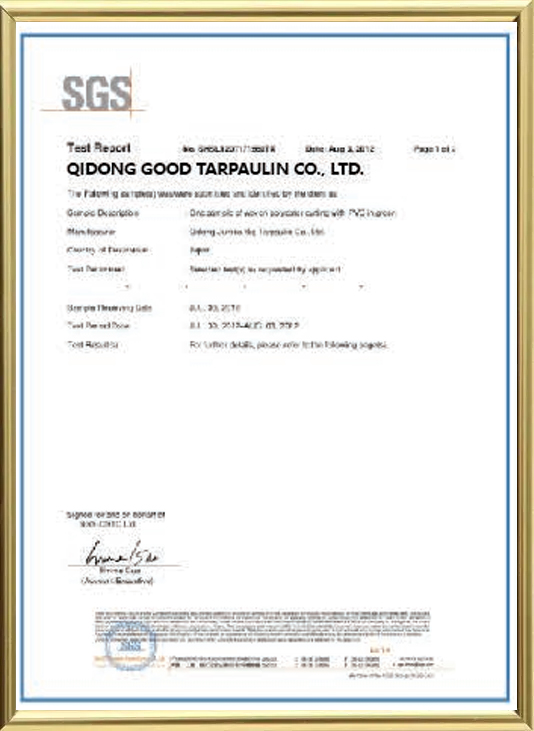
PC Certificate (Product Conformity Certificate): It needs to be applied for 3-6 months in advance. It is necessary to submit product instructions, technical specifications, third-party testing reports (covering high temperature resistance, UV resistance, fire protection and other indicators, the testing agency must be a Saudi accreditation agency, such as SGS) and production enterprise qualification certificates (such as ISO9001 international quality certification). It is valid for 1 year after passing the review. There is no need to repeat the application for multiple shipments of the same product.
SC Certificate (Shipping Conformity Certificate): It must be applied for before each batch of goods is shipped. A bill of lading, packing list, copy of the PC certificate and photos of the goods must be provided. The approval must be completed before the goods arrive at the port. Application after arrival will be considered invalid and will directly lead to customs clearance failure. For example, if a batch of construction canvas is exported to Riyadh without obtaining an SC certificate in advance, the goods will be detained by the customs upon arrival at the port, resulting in high demurrage charges.
(2) Special certification requirements for subdivided scenarios
Different application scenarios need to meet additional special standards:
Industrial scenario: Canvas used in the oil, gas and chemical industries must pass SASO 1470:2019 fire protection certification and IEC 61340-5-1 anti-static certification, and the test report must be issued by a laboratory recognized by Saudi Arabia.
Food contact scenarios: Canvas used for grain storage and agricultural product transportation must pass non-toxic testing by the Saudi Food and Drug Administration (SFDA). It is prohibited to contain harmful substances such as phthalates, and the detection limit must comply with the GSO 2820 standard.
Construction scene: Canvas used for construction site protection must provide a structural strength test report and comply with the requirements of the Saudi Building Code (SBC 304) for wind and sand resistance levels.
(3) Customs duties and import process regulations
Tariff policy: The basic tariff rate for PVC canvas imports is 12%, but if the product meets the "Gulf Cooperation Council (GCC) origin standard" (localization content ≥ 40%), it can enjoy GCC internal tariff reductions, reduced to less than 5%; if recyclable PVC materials are used, you can also apply for Saudi Arabia's "green import" subsidy to further reduce costs.
Import process: Customs declaration must be made by a local qualified importer in Saudi Arabia. The importer must have an "industrial supplies import license"; a complete document package (SABER certificate, test report, certificate of origin, packing list, invoice) must be submitted when the goods arrive at the port. The customs will conduct random sampling re-inspections. Goods that fail the re-inspection must be returned or destroyed within a time limit.
4. For the usage scenarios in Saudi Arabia, what are the “localization” techniques for the installation and maintenance of PVC canvas? What supporting services can Qidong Good Tarpaulin provide?
Under the extreme climate of Saudi Arabia, scientific installation and maintenance can extend the service life of PVC canvas by more than 50%. In addition to providing high-quality products, Qidong Good Tarpaulin can also provide supporting installation guidance and maintenance support:
(1) Installation: Sand prevention and high temperature prevention are the core
Qidong Good Tarpaulin will provide Saudi customers with a “Localized Installation Manual” (in Chinese, English and Arabic) to clarify the key operating points:
Enhanced outdoor fixing: When installing storage shed or tent canvas, it is recommended that the distance between fixed points be controlled at 0.8-1 meter, and hot-dip galvanized expansion bolts with a diameter of ≥12mm (can be supplied as a set) are used. A 10cm × 10cm metal gasket is installed at the bottom of the bolt to prevent the fixed points from falling off due to wind and sand impact; 15cm of sagging is required at the edge of the canvas to avoid tearing the fabric due to excessive wind resistance.
High-temperature isolation design: A 5mm-thick silicone insulation pad is supplied, and customers are instructed to install it at the contact point between the canvas and metal structures (such as steel pipes and containers) to prevent metal heat conduction from causing the parts of the canvas to soften due to high temperatures; the canvas used to cover oil tanks or equipment needs to be "suspended installation" and keep a distance of more than 30cm from the covered object to form an air convection layer to reduce the internal temperature.
Sandstorm emergency reinforcement: Before the sandstorm warning in northern desert areas, an additional windproof net (mesh size ≤ 5cm) needs to be installed on the outside of the canvas. At the same time, steel wire ropes are used to strengthen the canvas diagonally along the diagonal direction. The wire rope tension must reach more than 500N.
(2) Maintenance: Preventing wear and embrittlement is the key
Qidong Good Tarpaulin will provide customers with maintenance guides and supply supporting maintenance materials:
Sand cleaning and protection: After a sandstorm, the sand and dust on the canvas surface need to be cleaned within 24 hours. You can use a low-pressure water gun (water pressure ≤ 0.3MPa) to wash it in the downwind direction to avoid friction and damage to the coating by sand particles; spray a silicon-based protective agent on the canvas surface once a month to enhance its resistance to wind and sand wear.
High-temperature season maintenance: Check the coating condition every 2 months in summer. If there are signs of aging such as whitening or roughness, apply a special PVC repair agent (available as a package). When storing, you need to choose a cool and dry room to avoid direct contact with the ground (use a wooden pallet to raise it more than 50cm), and it is prohibited to mix with oil and chemicals.
Damage repair specifications: Small-area damage (diameter ≤ 3cm) can be pasted with PVC special repair tape (thickness ≥ 0.5mm, can be supplied), and the damaged area needs to be cleaned with alcohol before pasting; large-area damage (diameter > 3cm) requires the "patch reinforcement method". The patch material must be consistent with the original canvas, and the edges must be sewn with high-temperature-resistant double needles. The stitch spacing is ≤5mm to ensure that the tear resistance strength of the repaired area is not less than 80% of the original fabric.
In addition, Qidong Good Tarpaulin can provide remote inspection guidance to long-term customers every quarter. Through customer feedback on canvas usage photos, it can help determine the coating thickness, UV resistance and the condition of the fixing system, and provide timely reminders to replace aging accessories to ensure that the canvas is always in an effective state of protection. If customers have long-term and large demand, they can also explore the direction of product customization and optimization to further adapt to localized use scenarios in Saudi Arabia.



 Español